Most ebook files are in PDF format, so you can easily read them using various software such as Foxit Reader or directly on the Google Chrome browser.
Some ebook files are released by publishers in other formats such as .awz, .mobi, .epub, .fb2, etc. You may need to install specific software to read these formats on mobile/PC, such as Calibre.
Please read the tutorial at this link: https://ebookbell.com/faq
We offer FREE conversion to the popular formats you request; however, this may take some time. Therefore, right after payment, please email us, and we will try to provide the service as quickly as possible.
For some exceptional file formats or broken links (if any), please refrain from opening any disputes. Instead, email us first, and we will try to assist within a maximum of 6 hours.
EbookBell Team
4.4
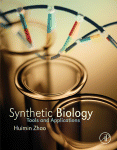
32 reviewsSynthetic Biology provides a framework to examine key enabling components in the emerging area of synthetic biology. Chapters contributed by leaders in the field address tools and methodologies developed for engineering biological systems at many levels, including molecular, pathway, network, whole cell, and multi-cell levels. The book highlights exciting practical applications of synthetic biology such as microbial production of biofuels and drugs, artificial cells, synthetic viruses, and artificial photosynthesis. The roles of computers and computational design are discussed, as well as future prospects in the field, including cell-free synthetic biology and engineering synthetic ecosystems.
Synthetic biology is the design and construction of new biological entities, such as enzymes, genetic circuits, and cells, or the redesign of existing biological systems. It builds on the advances in molecular, cell, and systems biology and seeks to transform biology in the same way that synthesis transformed chemistry and integrated circuit design transformed computing. The element that distinguishes synthetic biology from traditional molecular and cellular biology is the focus on the design and construction of core components that can be modeled, understood, and tuned to meet specific performance criteria and the assembly of these smaller parts and devices into larger integrated systems that solve specific biotechnology problems.
- Describes the latest state-of-the-art tools developed for low-cost synthesis of ever-increasing sizes of DNA and efficient modification of proteins, pathways, and genomes
- Highlights key technologies for analyzing biological systems at the genomic, proteomic, and metabolomic levels which are especially valuable in pathway, whole cell, and multi-cell applications
- Details mathematical modeling tools and computational tools which can dramatically increase the speed of the design process as well as reduce the cost of development.