Most ebook files are in PDF format, so you can easily read them using various software such as Foxit Reader or directly on the Google Chrome browser.
Some ebook files are released by publishers in other formats such as .awz, .mobi, .epub, .fb2, etc. You may need to install specific software to read these formats on mobile/PC, such as Calibre.
Please read the tutorial at this link: https://ebookbell.com/faq
We offer FREE conversion to the popular formats you request; however, this may take some time. Therefore, right after payment, please email us, and we will try to provide the service as quickly as possible.
For some exceptional file formats or broken links (if any), please refrain from opening any disputes. Instead, email us first, and we will try to assist within a maximum of 6 hours.
EbookBell Team
5.0
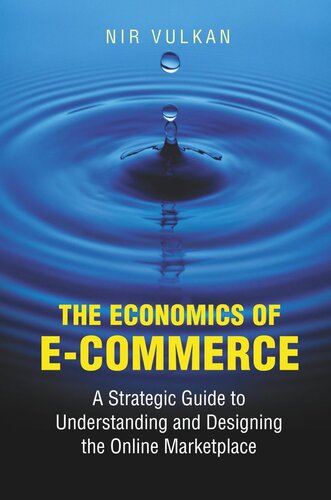
110 reviewsDespite the recent misfortunes of many dotcoms, e-commerce will have major and lasting effects on economic activity. But the rise and fall in the valuations of the first wave of e-commerce companies show that vague promises of distant profits are insufficient. Only business models based on sound economic propositions will survive. This book provides professionals, investors, and MBA students the tools they need to evaluate the wide range of actual and potential e-commerce businesses at the microeconomic level. It demonstrates how these tools can be used to assess a variety of existing applications.
Advances in web-based technology--particularly automation and delegation technologies such as smart agents, shopping bots, and bidding elves--support the further growth of e-commerce. In addition to enabling consumers to conduct automated comparisons and sellers to access visitors' background information in real time, such software programs can make decisions for individuals, negotiate with other programs, and participate in online markets. Much of e-commerce's economic value arises from this kind of automation, which not only reduces operating costs but adds value by generating new market interactions.
This text teaches how to analyze the added value of such applications, considering consumer behavior, pricing strategies, incentives, and other critical factors. It discusses added value in several e-commerce arenas: online shopping, business-to-business e-commerce, application design, online negotiation (one-to-one trading), online auctions (one-to-many trading), and many-to-many electronic exchanges. Combining insights from several years of microeconomic research as well as from game theory and computer science, it stresses the importance of economic engineering in application design as well as the need for business models to take into account the "total game."
As the only serious treatment of the microeconomics of e-commerce, this book should be read by anyone seeking e-commerce solutions or planning to work in the field.