Most ebook files are in PDF format, so you can easily read them using various software such as Foxit Reader or directly on the Google Chrome browser.
Some ebook files are released by publishers in other formats such as .awz, .mobi, .epub, .fb2, etc. You may need to install specific software to read these formats on mobile/PC, such as Calibre.
Please read the tutorial at this link: https://ebookbell.com/faq
We offer FREE conversion to the popular formats you request; however, this may take some time. Therefore, right after payment, please email us, and we will try to provide the service as quickly as possible.
For some exceptional file formats or broken links (if any), please refrain from opening any disputes. Instead, email us first, and we will try to assist within a maximum of 6 hours.
EbookBell Team
4.8
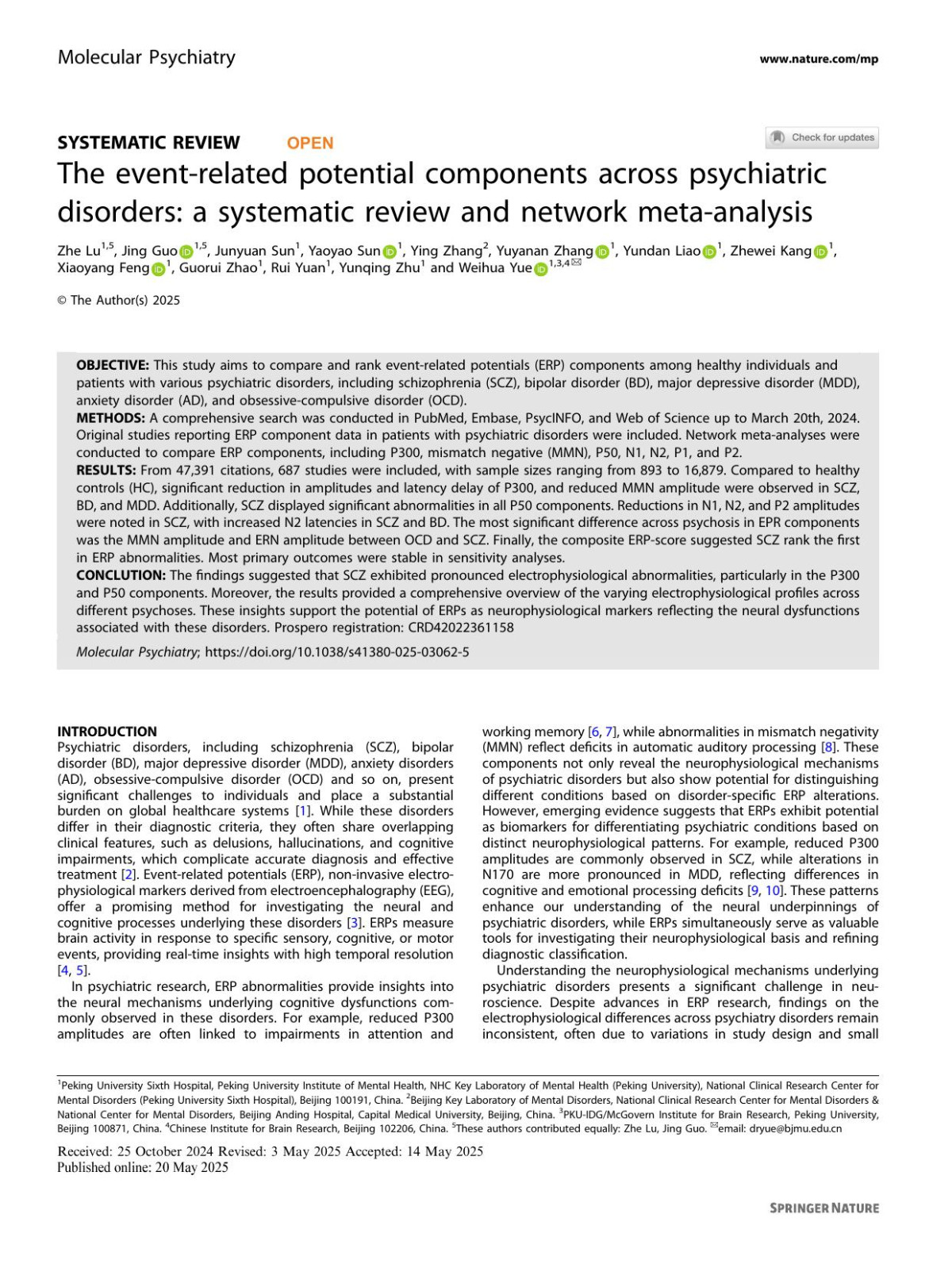
24 reviewsOBJECTIVE: This study aims to compare and rank event-related potentials (ERP) components among healthy individuals andpatients with various psychiatric disorders, including schizophrenia (SCZ), bipolar disorder (BD), major depressive disorder (MDD),anxiety disorder (AD), and obsessive-compulsive disorder (OCD).METHODS: A comprehensive search was conducted in PubMed, Embase, PsycINFO, and Web of Science up to March 20th, 2024.Original studies reporting ERP component data in patients with psychiatric disorders were included. Network meta-analyses wereconducted to compare ERP components, including P300, mismatch negative (MMN), P50, N1, N2, P1, and P2.RESULTS: From 47,391 citations, 687 studies were included, with sample sizes ranging from 893 to 16,879. Compared to healthy1234567890();,:controls (HC), significant reduction in amplitudes and latency delay of P300, and reduced MMN amplitude were observed in SCZ,BD, and MDD. Additionally, SCZ displayed significant abnormalities in all P50 components. Reductions in N1, N2, and P2 amplitudeswere noted in SCZ, with increased N2 latencies in SCZ and BD. The most significant difference across psychosis in EPR componentswas the MMN amplitude and ERN amplitude between OCD and SCZ. Finally, the composite ERP-score suggested SCZ rank the firstin ERP abnormalities. Most primary outcomes were stable in sensitivity analyses.CONCLUTION: The findings suggested that SCZ exhibited pronounced electrophysiological abnormalities, particularly in the P300and P50 components. Moreover, the results provided a comprehensive overview of the varying electrophysiological profiles acrossdifferent psychoses. These insights support the potential of ERPs as neurophysiological markers reflecting the neural dysfunctionsassociated with these disorders. Prospero registration: CRD42022361158Molecular Psychiatry;