Most ebook files are in PDF format, so you can easily read them using various software such as Foxit Reader or directly on the Google Chrome browser.
Some ebook files are released by publishers in other formats such as .awz, .mobi, .epub, .fb2, etc. You may need to install specific software to read these formats on mobile/PC, such as Calibre.
Please read the tutorial at this link: https://ebookbell.com/faq
We offer FREE conversion to the popular formats you request; however, this may take some time. Therefore, right after payment, please email us, and we will try to provide the service as quickly as possible.
For some exceptional file formats or broken links (if any), please refrain from opening any disputes. Instead, email us first, and we will try to assist within a maximum of 6 hours.
EbookBell Team
5.0
38 reviews“There Is Life on the Planet Mars” —New York Times, December 9, 1906
This New York Times headline was no joke.
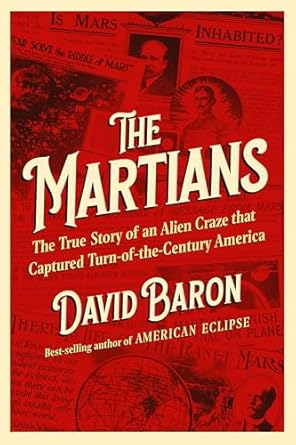
In the early 1900’s, many Americans actually believed we had discovered intelligent life on Mars, as best-selling science writer David Baron chronicles in The Martians, his truly bizarre tale of a nation swept up in Mars mania.
At the center of Baron’s historical drama is Percival Lowell, the Boston Brahmin and Harvard scion, who observed “canals” etched into the surface of Mars. Lowell devised a grand theory that the red planet was home to a utopian society that had built gargantuan ditches to funnel precious meltwater from the polar icecaps to desert farms and oasis cities. The public fell in love with the ambitious amateur astronomer who shared his findings in speeches and wildly popular books.
While at first people treated the Martians whimsically—Martians headlining Broadway shows, biologists speculating whether they were winged or gilled—the discussion quickly became serious. Inventor Nikola Tesla announced he had received radio signals from Mars; Alexander Graham Bell agreed there was “no escape from the conviction” that intelligent beings inhabited the planet. Martian excitement reached its zenith when Lowell financed an expedition to photograph Mars from Chile’s Atacama Desert, resulting in what newspapers hailed as proof of the Martian canals’ existence.
Triumph quickly yielded to tragedy. Those wild claims and highly speculative photographs emboldened Lowell’s critics, whose withering attacks gathered steam and eventually wrecked the man and his theory—but not the fervor he had started. Although Lowell would die discredited and delusional in 1916, the Mars frenzy spurred a nascent literary genre called science fiction, and the world’s sense of its place in the universe would never be the same.
Today, the red planet maintains its grip on the public’s imagination...