Most ebook files are in PDF format, so you can easily read them using various software such as Foxit Reader or directly on the Google Chrome browser.
Some ebook files are released by publishers in other formats such as .awz, .mobi, .epub, .fb2, etc. You may need to install specific software to read these formats on mobile/PC, such as Calibre.
Please read the tutorial at this link: https://ebookbell.com/faq
We offer FREE conversion to the popular formats you request; however, this may take some time. Therefore, right after payment, please email us, and we will try to provide the service as quickly as possible.
For some exceptional file formats or broken links (if any), please refrain from opening any disputes. Instead, email us first, and we will try to assist within a maximum of 6 hours.
EbookBell Team
4.0
6 reviews
ISBN 10: 1119706963
ISBN 13: 9781119706960
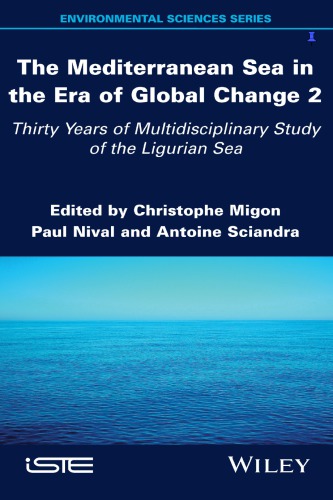
Author: Christophe Migon, Paul Nival, Antoine Sciandra
Due to its particular characteristics, the Mediterranean Sea is often viewed as a microcosm of the World Ocean. Its proportionally-reduced dimensions and peculiar hydrological circulation render it susceptible to environmental and climatic constraints, which are rapidly evolving. The Mediterranean is therefore an ideal site to examine, in order to better understand a number of key oceanographic phenomena. This is especially true of the Ligurian Sea where, due to its geology, oceanic conditions are found close to the coast.
As such, 30 years ago, an offshore time-series site provided a fresh impetus to a long history of marine biology research, which has generated a very important body of data and knowledge. This is the first volume, in a two-volume series, that summarizes this research. Across these two books, the reader will find 13 chapters that examine the geology, physics, chemistry and biology of the Ligurian Sea ? always with the goal of providing key elements of oceanography in a changing world.
Chapter 1. The Development of Knowledge of the Ligurian Sea
Chapter 2. The Ligurian Basin: A Geomorphologic and Geological Background
Chapter 3. Physical Oceanography of the Ligurian Sea
Chapter 4. The Carbonate System in the Ligurian Sea
Chapter 5. Emission Sources, Fluxes and Spatiotemporal Distribution of Nutritive Resources
Chapter 6. Primary Production in the Ligurian Sea
Chapter 7. Pelagic Viruses, Bacteria and Archaea
the mediterranean sea climate
the mediterranean sea on the world map
the mediterranean sea borders these countries
the mediterranean sea is
a mediterranean climate
Tags: Christophe Migon, Paul Nival, Antoine Sciandra, Mediterranean Sea, Global Change, Ligurian Sea, Multidisciplinary Study