logo

EbookBell.com

Most ebook files are in PDF format, so you can easily read them using various software such as Foxit Reader or directly on the Google Chrome browser.
Some ebook files are released by publishers in other formats such as .awz, .mobi, .epub, .fb2, etc. You may need to install specific software to read these formats on mobile/PC, such as Calibre.

Please read the tutorial at this link:  https://ebookbell.com/faq 


We offer FREE conversion to the popular formats you request; however, this may take some time. Therefore, right after payment, please email us, and we will try to provide the service as quickly as possible.


For some exceptional file formats or broken links (if any), please refrain from opening any disputes. Instead, email us first, and we will try to assist within a maximum of 6 hours.

EbookBell Team
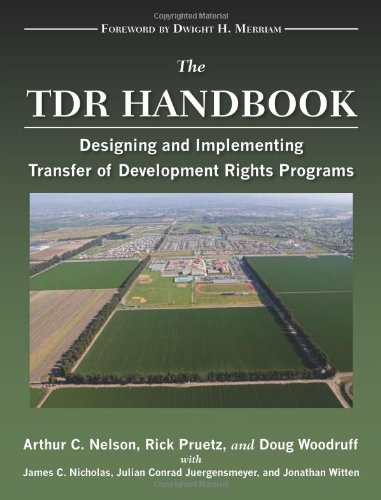
The Tdr Handbook Designing And Implementing Transfer Of Development Rights Programs Dr Arthur C Nelson Phd Faicp

  • SKU: BELL-2489170
The Tdr Handbook Designing And Implementing Transfer Of Development Rights Programs Dr Arthur C Nelson Phd Faicp
$ 35.00 $ 45.00 (-22%)

4.4

92 reviews

The Tdr Handbook Designing And Implementing Transfer Of Development Rights Programs Dr Arthur C Nelson Phd Faicp instant download after payment.

Publisher: Island Press
File Extension: PDF
File size: 2.23 MB
Pages: 342
Author: Dr. Arthur C. Nelson Ph.D. FAICP, Rick Pruetz, Doug Woodruff
ISBN: 9781597269810, 1597269816
Language: English
Year: 2011

Product desciption

The Tdr Handbook Designing And Implementing Transfer Of Development Rights Programs Dr Arthur C Nelson Phd Faicp by Dr. Arthur C. Nelson Ph.d. Faicp, Rick Pruetz, Doug Woodruff 9781597269810, 1597269816 instant download after payment.

"Transfer of Development Rights" (TDR) programs allow local governments to put economic principles to work in encouraging good land use planning. TDR programs most often permit landowners to forfeit development rights in areas targeted for preservation and then sell those development rights to buyers who want to increase the density of development in areas designated as growth areas by local authorities.   Although TDR programs must conform to zoning laws, they provide market incentives that make them more equitable (and often more lucrative) for sellers and frequently benefit buyers by allowing them to receive prior approval for their high-density development plans. Since the 1970s when modern TDR applications were first conceived, more than 200 communities in 33 states across the U.S. have implemented TDR-based programs. The most common uses of TDR to date involve protecting farmland, environmentally sensitive land, historic sites, and "rural character," and urban revitalization. Until now, however, there has never been a clearly written, one-volume book on the subject. At last, The TDR Handbook provides a comprehensive guide to every aspect of TDR programs, from the thinking behind them to the nuts and bolts of implementation-including statutory guidance, model ordinances, suggestions for program administration, and comparisons with other types of preservation programs. In addition, six of its twenty chapters are devoted to case studies of all major uses to which TDR programs have been utilized to date, including recent urban revitalization projects that utilize TDR principles.  

Related Products