Most ebook files are in PDF format, so you can easily read them using various software such as Foxit Reader or directly on the Google Chrome browser.
Some ebook files are released by publishers in other formats such as .awz, .mobi, .epub, .fb2, etc. You may need to install specific software to read these formats on mobile/PC, such as Calibre.
Please read the tutorial at this link: https://ebookbell.com/faq
We offer FREE conversion to the popular formats you request; however, this may take some time. Therefore, right after payment, please email us, and we will try to provide the service as quickly as possible.
For some exceptional file formats or broken links (if any), please refrain from opening any disputes. Instead, email us first, and we will try to assist within a maximum of 6 hours.
EbookBell Team
4.0
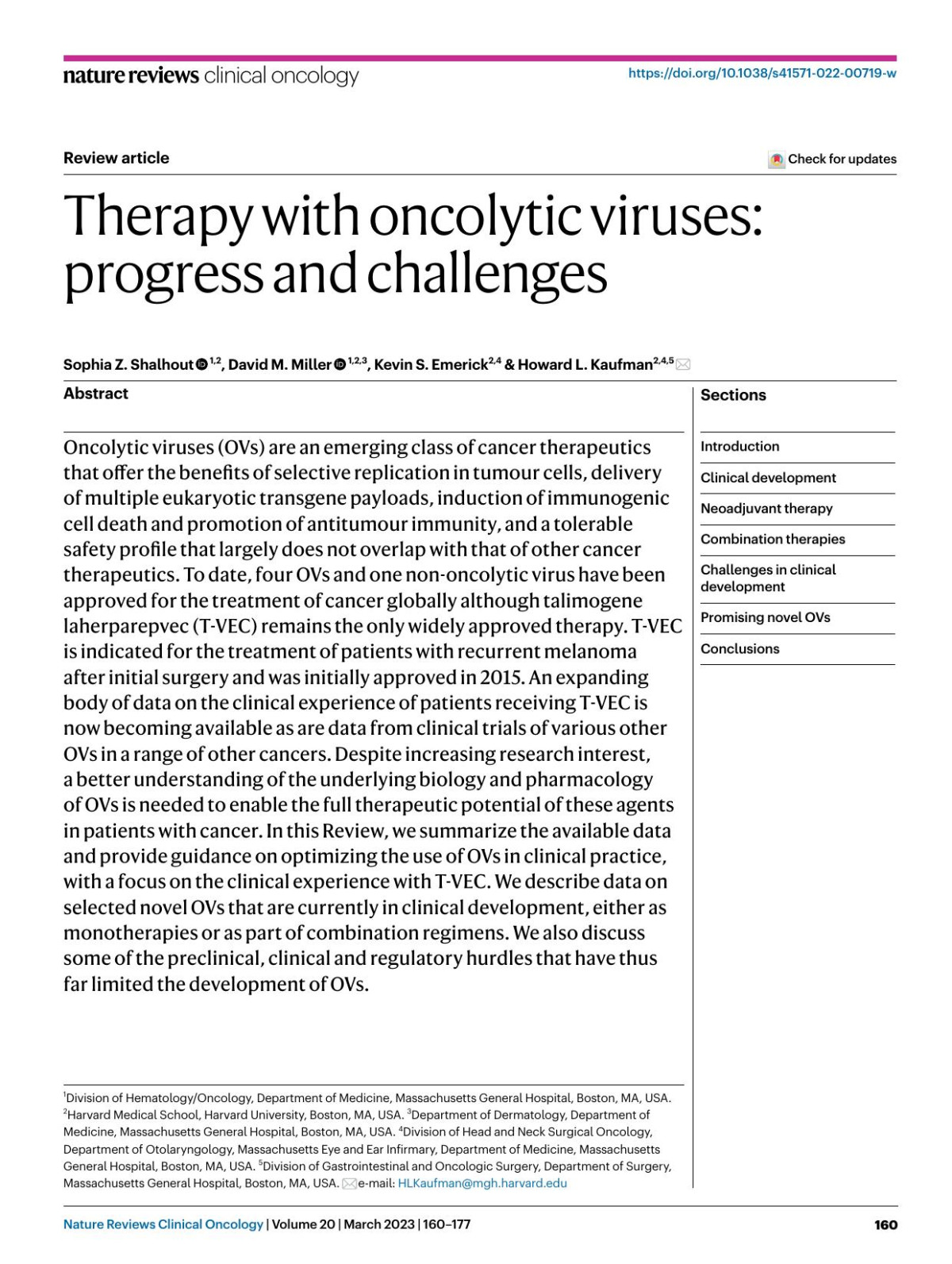
56 reviewsOncolytic viruses (OVs) are an emerging class of cancer therapeutics Introductionthat ofer the benefts of selective replication in tumour cells, delivery Clinical developmentof multiple eukaryotic transgene payloads, induction of immunogenic Neoadjuvant therapycell death and promotion of antitumour immunity, and a tolerable Combination therapiessafety profle that largely does not overlap with that of other cancer therapeutics. To date, four OVs and one non-oncolytic virus have been Challenges in clinical developmentapproved for the treatment of cancer globally although talimogene Promising novel OVslaherparepvec (T-VEC) remains the only widely approved therapy. T-VEC is indicated for the treatment of patients with recurrent melanoma Conclusionsafter initial surgery and was initially approved in 2015. An expanding body of data on the clinical experience of patients receiving T-VEC is now becoming available as are data from clinical trials of various other OVs in a range of other cancers. Despite increasing research interest, a better understanding of the underlying biology and pharmacology of OVs is needed to enable the full therapeutic potential of these agents in patients with cancer. In this Review, we summarize the available data and provide guidance on optimizing the use of OVs in clinical practice, with a focus on the clinical experience with T-VEC. We describe data on selected novel OVs that are currently in clinical development, either as monotherapies or as part of combination regimens. We also discuss some of the preclinical, clinical and regulatory hurdles that have thus far limited the development of OVs.