logo

EbookBell.com

Most ebook files are in PDF format, so you can easily read them using various software such as Foxit Reader or directly on the Google Chrome browser.
Some ebook files are released by publishers in other formats such as .awz, .mobi, .epub, .fb2, etc. You may need to install specific software to read these formats on mobile/PC, such as Calibre.

Please read the tutorial at this link:  https://ebookbell.com/faq 


We offer FREE conversion to the popular formats you request; however, this may take some time. Therefore, right after payment, please email us, and we will try to provide the service as quickly as possible.


For some exceptional file formats or broken links (if any), please refrain from opening any disputes. Instead, email us first, and we will try to assist within a maximum of 6 hours.

EbookBell Team
Therapyinduced Senescence Is A Transient Drug Resistance Mechanism In Breast Cancer Eszter Bajtai Csaba Kiss éva Bakos Tamás Langó Anna Lovrics éva Schád Viktória Tisza Károly Hegedűs Péter Fürjes Zoltán Szabó Gábor E Tusnády Gergely Szakács ágnes Tantos Sándor Spisák József Tóvári András Füredi

  • SKU: BELL-235861006
Therapyinduced Senescence Is A Transient Drug Resistance Mechanism In Breast Cancer Eszter Bajtai Csaba Kiss éva Bakos Tamás Langó Anna Lovrics éva Schád Viktória Tisza Károly Hegedűs Péter Fürjes Zoltán Szabó Gábor E Tusnády Gergely Szakács ágnes Tantos Sándor Spisák József Tóvári András Füredi
$ 35.00 $ 45.00 (-22%)

4.3

8 reviews

Therapyinduced Senescence Is A Transient Drug Resistance Mechanism In Breast Cancer Eszter Bajtai Csaba Kiss éva Bakos Tamás Langó Anna Lovrics éva Schád Viktória Tisza Károly Hegedűs Péter Fürjes Zoltán Szabó Gábor E Tusnády Gergely Szakács ágnes Tantos Sándor Spisák József Tóvári András Füredi instant download after payment.

Publisher: x
File Extension: PDF
File size: 6.49 MB
Author: Eszter Bajtai & Csaba Kiss & Éva Bakos & Tamás Langó & Anna Lovrics & Éva Schád & Viktória Tisza & Károly Hegedűs & Péter Fürjes & Zoltán Szabó & Gábor E. Tusnády & Gergely Szakács & Ágnes Tantos & Sándor Spisák & József Tóvári & András Füredi
Language: English
Year: 2025

Product desciption

Therapyinduced Senescence Is A Transient Drug Resistance Mechanism In Breast Cancer Eszter Bajtai Csaba Kiss éva Bakos Tamás Langó Anna Lovrics éva Schád Viktória Tisza Károly Hegedűs Péter Fürjes Zoltán Szabó Gábor E Tusnády Gergely Szakács ágnes Tantos Sándor Spisák József Tóvári András Füredi by Eszter Bajtai & Csaba Kiss & Éva Bakos & Tamás Langó & Anna Lovrics & Éva Schád & Viktória Tisza & Károly Hegedűs & Péter Fürjes & Zoltán Szabó & Gábor E. Tusnády & Gergely Szakács & Ágnes Tantos & Sándor Spisák & József Tóvári & András Füredi instant download after payment.

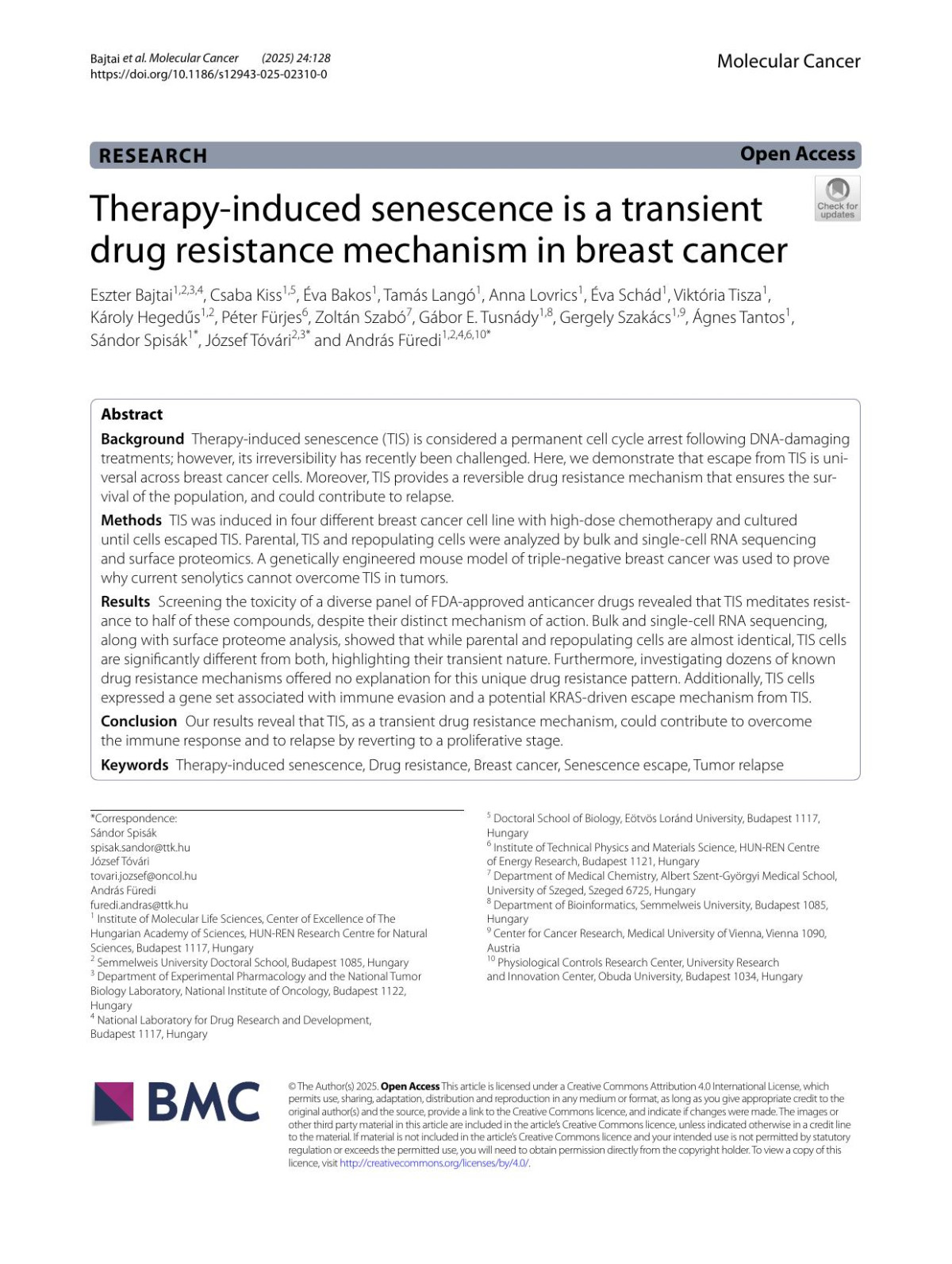
Molecular Cancer,AbstractBackground Therapy-induced senescence (TIS) is considered a permanent cell cycle arrest following DNA-damaging treatments; however, its irreversibility has recently been challenged. Here, we demonstrate that escape from TIS is universal across breast cancer cells. Moreover, TIS provides a reversible drug resistance mechanism that ensures the survival of the population, and could contribute to relapse.Methods TIS was induced in four diferent breast cancer cell line with high-dose chemotherapy and cultured until cells escaped TIS. Parental, TIS and repopulating cells were analyzed by bulk and single-cell RNA sequencing and surface proteomics. A genetically engineered mouse model of triple-negative breast cancer was used to prove why current senolytics cannot overcome TIS in tumors.Results Screening the toxicity of a diverse panel of FDA-approved anticancer drugs revealed that TIS meditates resistance to half of these compounds, despite their distinct mechanism of action. Bulk and single-cell RNA sequencing, along with surface proteome analysis, showed that while parental and repopulating cells are almost identical, TIS cells are signifcantly diferent from both, highlighting their transient nature. Furthermore, investigating dozens of known drug resistance mechanisms ofered no explanation for this unique drug resistance pattern. Additionally, TIS cells expressed a gene set associated with immune evasion and a potential KRAS-driven escape mechanism from TIS.Conclusion Our results reveal that TIS, as a transient drug resistance mechanism, could contribute to overcome the immune response and to relapse by reverting to a proliferative stage.Keywords Therapy-induced senescence, Drug resistance, Breast cancer, Senescence escape, Tumor relapse

Related Products