Most ebook files are in PDF format, so you can easily read them using various software such as Foxit Reader or directly on the Google Chrome browser.
Some ebook files are released by publishers in other formats such as .awz, .mobi, .epub, .fb2, etc. You may need to install specific software to read these formats on mobile/PC, such as Calibre.
Please read the tutorial at this link: https://ebookbell.com/faq
We offer FREE conversion to the popular formats you request; however, this may take some time. Therefore, right after payment, please email us, and we will try to provide the service as quickly as possible.
For some exceptional file formats or broken links (if any), please refrain from opening any disputes. Instead, email us first, and we will try to assist within a maximum of 6 hours.
EbookBell Team
4.0
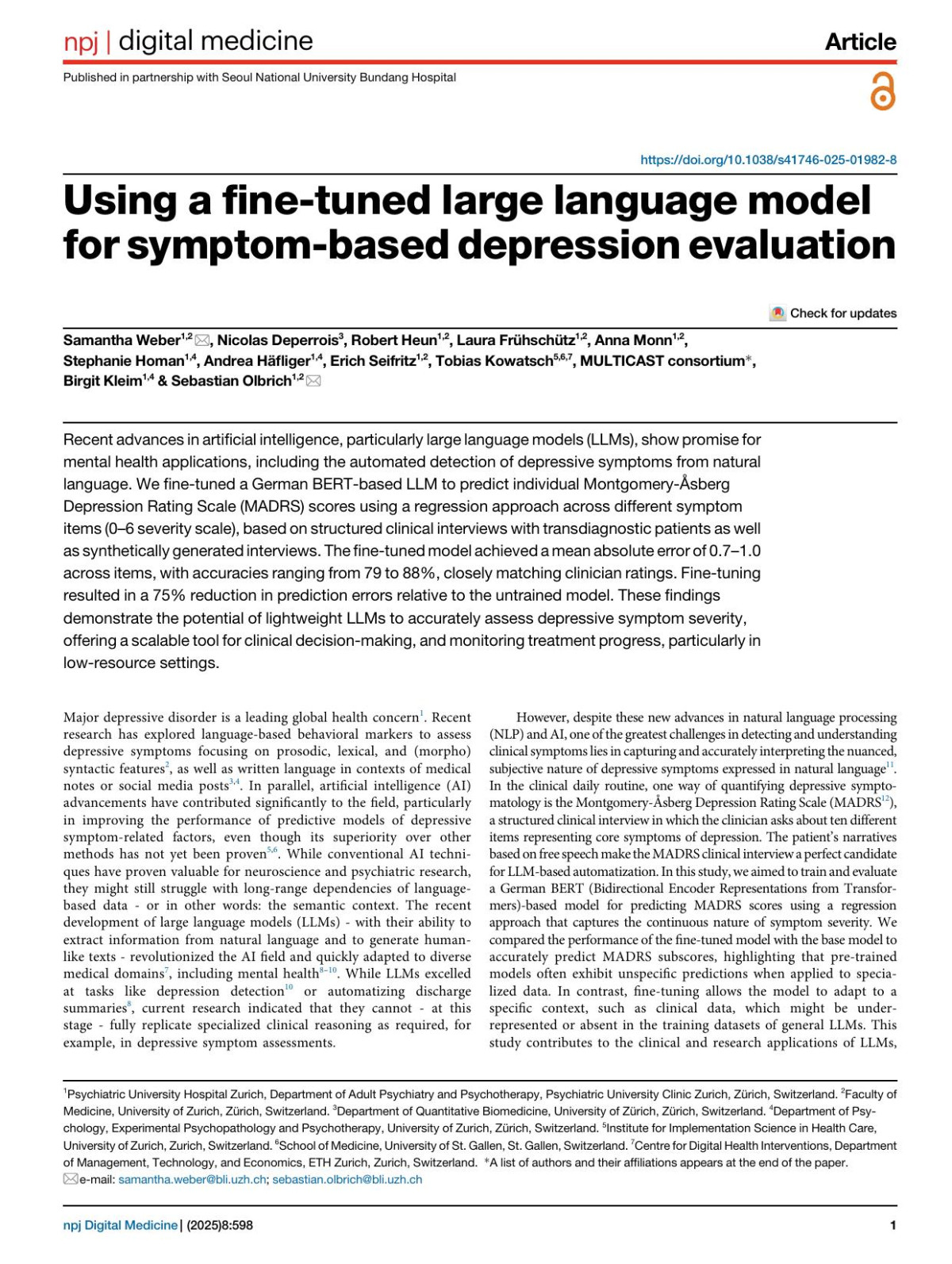
16 reviewsRecent advances in artificial intelligence, particularly large language models (LLMs), show promise formental health applications, including the automated detection of depressive symptoms from natural1234567890():,;1234567890():,;language. We fine-tuned a German BERT-based LLM to predict individual Montgomery-ÅsbergDepression Rating Scale (MADRS) scores using a regression approach across different symptomitems (0–6 severity scale), based on structured clinical interviews with transdiagnostic patients as wellas synthetically generated interviews. The fine-tuned model achieved a mean absolute error of 0.7–1.0across items, with accuracies ranging from 79 to 88%, closely matching clinician ratings. Fine-tuningresulted in a 75% reduction in prediction errors relative to the untrained model. These findingsdemonstrate the potential of lightweight LLMs to accurately assess depressive symptom severity,offering a scalable tool for clinical decision-making, and monitoring treatment progress, particularly inlow-resource settings.