logo

EbookBell.com

Most ebook files are in PDF format, so you can easily read them using various software such as Foxit Reader or directly on the Google Chrome browser.
Some ebook files are released by publishers in other formats such as .awz, .mobi, .epub, .fb2, etc. You may need to install specific software to read these formats on mobile/PC, such as Calibre.

Please read the tutorial at this link:  https://ebookbell.com/faq 


We offer FREE conversion to the popular formats you request; however, this may take some time. Therefore, right after payment, please email us, and we will try to provide the service as quickly as possible.


For some exceptional file formats or broken links (if any), please refrain from opening any disputes. Instead, email us first, and we will try to assist within a maximum of 6 hours.

EbookBell Team
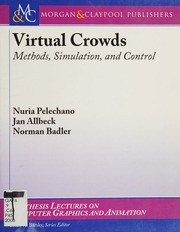
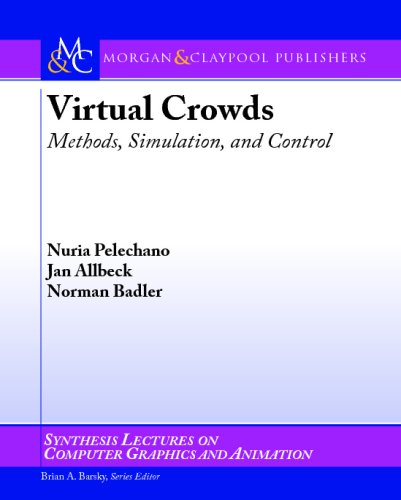
Virtual Crowds Methods Simulation And Control Pelechano Nuria

  • SKU: BELL-238182710
Virtual Crowds Methods Simulation And Control Pelechano Nuria
$ 35.00 $ 45.00 (-22%)

4.4

62 reviews

Virtual Crowds Methods Simulation And Control Pelechano Nuria instant download after payment.

Publisher: Cham, Switzerland : Springer
File Extension: PDF
File size: 12.52 MB
Author: Pelechano, Nuria, Allbeck, Jan M; Badler, Norman I
Language: English
Year: 2008

Product desciption

Virtual Crowds Methods Simulation And Control Pelechano Nuria by Pelechano, Nuria, Allbeck, Jan M; Badler, Norman I instant download after payment.

1 online resource (xii, 176 pages) :, There are many applications of computer animation and simulation where it is necessary to model virtual crowds of autonomous agents. Some of these applications include site planning, education, entertainment, training, and human factors analysis for building evacuation. Other applications include simulations of scenarios where masses of people gather, flow, and disperse, such as transportation centers, sporting events, and concerts. Most crowd simulations include only basic locomotive behaviors possibly coupled with a few stochastic actions. Our goal in this survey is to establish a baseline of techniques and requirements for simulating large-scale virtual human populations. Sometimes, these populations might be mutually engaged in a common activity such as evacuation from a building or area; other times they may be going about their individual and personal agenda of work, play, leisure, travel, or spectator. Computational methods to model one set of requirements may not mesh well with good approaches to another. By including both crowd and individual goals and constraints into a comprehensive computational model, we expect to simulate the visual texture and contextual behaviors of groups of seemingly sentient beings, Title from PDF title page (viewed Oct. 30, 2008), Includes bibliographical references (pages 163-174), Crowd simulation methodology survey -- Individual differences in crowds -- Framework (HiDAC + MACES + CAROSA) -- HiDAC : local motion -- MACES : wayfinding with communication and roles -- CAROSA : functional crowds -- Initializing a scenario -- Evaluating crowds, Introduction -- Terminology -- Overview -- Lessons learned from the psychology literature -- Main features in crowd simulation systems -- Crowd simulation methodology survey -- Microscopic and macroscopic approaches used to model pedestrian movements -- Microscopic models -- Social force models -- Cellular automata models -- Rule-based models --…

Related Products