logo

EbookBell.com

Most ebook files are in PDF format, so you can easily read them using various software such as Foxit Reader or directly on the Google Chrome browser.
Some ebook files are released by publishers in other formats such as .awz, .mobi, .epub, .fb2, etc. You may need to install specific software to read these formats on mobile/PC, such as Calibre.

Please read the tutorial at this link:  https://ebookbell.com/faq 


We offer FREE conversion to the popular formats you request; however, this may take some time. Therefore, right after payment, please email us, and we will try to provide the service as quickly as possible.


For some exceptional file formats or broken links (if any), please refrain from opening any disputes. Instead, email us first, and we will try to assist within a maximum of 6 hours.

EbookBell Team
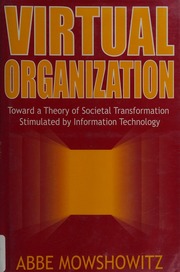
Virtual Organization Toward A Theory Of Societal Transformation Stimulated By Information Technology Mowshowitz

  • SKU: BELL-238168584
Virtual Organization Toward A Theory Of Societal Transformation Stimulated By Information Technology Mowshowitz
$ 35.00 $ 45.00 (-22%)

4.0

96 reviews

Virtual Organization Toward A Theory Of Societal Transformation Stimulated By Information Technology Mowshowitz instant download after payment.

Publisher: Westport, Conn. : Quorum Books
File Extension: PDF
File size: 15.8 MB
Author: Mowshowitz, Abbe
Language: English
Year: 2002

Product desciption

Virtual Organization Toward A Theory Of Societal Transformation Stimulated By Information Technology Mowshowitz by Mowshowitz, Abbe instant download after payment.

xvi, 264 pages ; 24 cm, \"Computers mediate. They serve as brokers in matching buyers to sellers, employees to employers, resources to work processes, and on it goes. The social significance of computers as mediators and brokers has tremendous political and economic consequences. For managers, these consequences manifest themselves most clearly in the virtual organization, which is founded on the separation of requirements (e.g., inputs, such as components) from the ways in which requirements are met (e.g., suppliers and distribution networks). Separating these elements allows managers to switch easily from one way of meeting a requirement to another, for example, by laying off higher paid workers in the U.S. and hiring cheaper foreign labor.\"--Jacket, Includes bibliographical references (pages 241-248) and index, Foreword / Murray Turoff -- Ch. 1. Intimations of a New Order -- Ch. 2. Virtual Organization -- Ch. 3. Information Commodities -- Ch. 4. Mobile Capital and Instant Payments -- Ch. 5. Standardized Business Relationships -- Ch. 6. Emerging Virtual Enterprises -- Ch. 7. Privatization of Government, Expatriation of Business -- Ch. 8. A New Political Economy -- Ch. 9. The Virtual Manor: Consumption, Work, and Identity -- Ch. 10. The Virtual Manor: Family and Community

Related Products