logo

EbookBell.com

Most ebook files are in PDF format, so you can easily read them using various software such as Foxit Reader or directly on the Google Chrome browser.
Some ebook files are released by publishers in other formats such as .awz, .mobi, .epub, .fb2, etc. You may need to install specific software to read these formats on mobile/PC, such as Calibre.

Please read the tutorial at this link:  https://ebookbell.com/faq 


We offer FREE conversion to the popular formats you request; however, this may take some time. Therefore, right after payment, please email us, and we will try to provide the service as quickly as possible.


For some exceptional file formats or broken links (if any), please refrain from opening any disputes. Instead, email us first, and we will try to assist within a maximum of 6 hours.

EbookBell Team
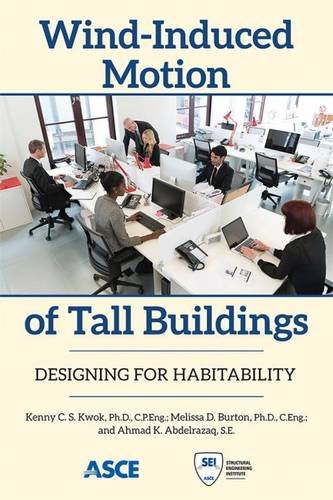
Windinduced Motion Of Tall Buildings Designing For Habitability Abdelrazaq

  • SKU: BELL-5394692
Windinduced Motion Of Tall Buildings Designing For Habitability Abdelrazaq
$ 35.00 $ 45.00 (-22%)

4.8

54 reviews

Windinduced Motion Of Tall Buildings Designing For Habitability Abdelrazaq instant download after payment.

Publisher: American Society of Civil Engineers
File Extension: PDF
File size: 2.56 MB
Pages: 77
Author: Abdelrazaq, Ahmad K.; Burton, Melissa D.; Kwok, Kenny C. S
ISBN: 9780784413852, 9780784478929, 9781680157444, 0784413851, 0784478929, 1680157442
Language: English
Year: 2015

Product desciption

Windinduced Motion Of Tall Buildings Designing For Habitability Abdelrazaq by Abdelrazaq, Ahmad K.; Burton, Melissa D.; Kwok, Kenny C. S 9780784413852, 9780784478929, 9781680157444, 0784413851, 0784478929, 1680157442 instant download after payment.

Tall and super-tall buildings are going up all over the world, notably in east and south Asia, the Pacific Rim and the Middle East. Advances in materials, structural design, and wind enginerring ensure that these buildings meet strength and safety requirements. But wind-induced building motion can cause structures to creak and groan, elevator cables to clash, horizons to ''swing,'' and human occupants to feel dizzy, nausea, or highly anxious. Wind-Induced Motion of Tall Buildings presents an overview of current research on occupant response to motion in tall buildings. This state-of-the-art report describes the physiology and psychology of the human perception of motion and explains the factors that can be used to characterize a building's movement. The authors summarize the results of field studies and motion simulator experiments that examine human perception of and tolerance for building motion. they survey the serviceability criteria adopted by international standards organizations and offer general acceptance guidelines based on peak acceleration thresholds. Finally, they identify design strategies that can mitigate wind-induced building motion through structural optimization, aerodynamics treatment, and vibration dissipation or absorption. The human tolerance for wind-induced building motion can vary greatly and poses a challenge in new buildings of ever-increasing height and complexity of shape. property developers, building owners, and design professionals working on tall buildings will use this report to ensure that occupants remain comfortable and secure in tall buildings during periods of strong wind

Related Products