logo

EbookBell.com

Most ebook files are in PDF format, so you can easily read them using various software such as Foxit Reader or directly on the Google Chrome browser.
Some ebook files are released by publishers in other formats such as .awz, .mobi, .epub, .fb2, etc. You may need to install specific software to read these formats on mobile/PC, such as Calibre.

Please read the tutorial at this link:  https://ebookbell.com/faq 


We offer FREE conversion to the popular formats you request; however, this may take some time. Therefore, right after payment, please email us, and we will try to provide the service as quickly as possible.


For some exceptional file formats or broken links (if any), please refrain from opening any disputes. Instead, email us first, and we will try to assist within a maximum of 6 hours.

EbookBell Team
Hmgcs1 Variants Cause Rigid Spine Syndrome Amenable To Mevalonic Acid Treatment In An Animal Model Olein N H Dofash

  • SKU: BELL-234833820
Hmgcs1 Variants Cause Rigid Spine Syndrome Amenable To Mevalonic Acid Treatment In An Animal Model Olein N H Dofash
$ 35.00 $ 45.00 (-22%)

0.0

0 reviews

Hmgcs1 Variants Cause Rigid Spine Syndrome Amenable To Mevalonic Acid Treatment In An Animal Model Olein N H Dofash instant download after payment.

Publisher: ×
File Extension: PDF
File size: 2.23 MB
Author: OLein N. H. Dofash, It Lee B. Miles, 2, t oYoshihiko Saito, 3 Eloy Rivas
ISBN: 101093/BRAIN/AWAE371
Language: English
Year: 2025

Product desciption

Hmgcs1 Variants Cause Rigid Spine Syndrome Amenable To Mevalonic Acid Treatment In An Animal Model Olein N H Dofash by Olein N. H. Dofash, It Lee B. Miles, 2, T Oyoshihiko Saito, 3 Eloy Rivas 101093/BRAIN/AWAE371 instant download after payment.

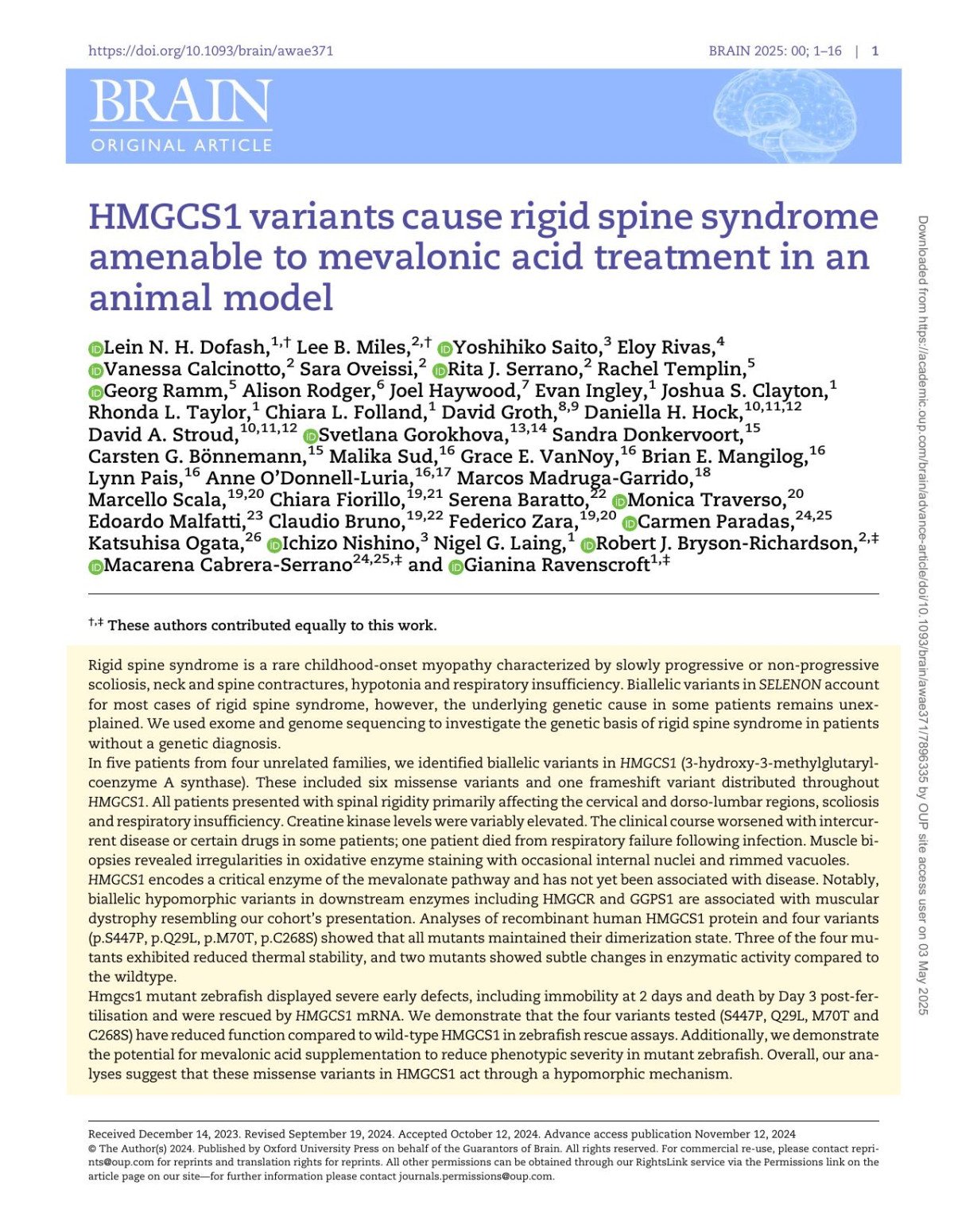
DOI: 10.1093/brain/awae371; Brain, 2024-11-12.; Abstract: Rigid spine syndrome is a rare childhood-onset myopathy characterized by slowly progressive or non-progressive scoliosis, neck and spine contractures, hypotonia and respiratory insufficiency. Biallelic variants in SELENON account for most cases of rigid spine syndrome, however, the underlying genetic cause in some patients remains unexplained. We used exome and genome sequencing to investigate the genetic basis of rigid spine syndrome in patients without a genetic diagnosis.In five patients from four unrelated families, we identified biallelic variants in HMGCS1 (3-hydroxy-3-methylglutaryl-coenzyme A synthase). These included six missense variants and one frameshift variant distributed throughout HMGCS1. All patients presented with spinal rigidity primarily affecting the cervical and dorso-lumbar regions, scoliosis and respiratory insufficiency. Creatine kinase levels were variably elevated. The clinical course worsened with intercurrent disease or certain drugs in some patients; one patient died from respiratory failure following infection. Muscle biopsies revealed irregularities in oxidative enzyme staining with occasional internal nuclei and rimmed vacuoles.HMGCS1 encodes a critical enzyme of the mevalonate pathway and has not yet been associated with disease. Notably, biallelic hypomorphic variants in downstream enzymes including HMGCR and GGPS1 are associated with muscular dystrophy resembling our cohort’s presentation. Analyses of recombinant human HMGCS1 protein and four variants (p.S447P, p.Q29L, p.M70T, p.C268S) showed that all mutants maintained their dimerization state. Three of the four mutants exhibited reduced thermal stability, and two mutants showed subtle changes in enzymatic activity compared to the wildtype.Hmgcs1 mutant zebrafish displayed severe early defects, including immobility at 2 days and death by Day 3 post-fertilisation and were rescued by HMGCS1 mRNA. We demonstrate that the fou

Related Products