logo

EbookBell.com

Most ebook files are in PDF format, so you can easily read them using various software such as Foxit Reader or directly on the Google Chrome browser.
Some ebook files are released by publishers in other formats such as .awz, .mobi, .epub, .fb2, etc. You may need to install specific software to read these formats on mobile/PC, such as Calibre.

Please read the tutorial at this link:  https://ebookbell.com/faq 


We offer FREE conversion to the popular formats you request; however, this may take some time. Therefore, right after payment, please email us, and we will try to provide the service as quickly as possible.


For some exceptional file formats or broken links (if any), please refrain from opening any disputes. Instead, email us first, and we will try to assist within a maximum of 6 hours.

EbookBell Team
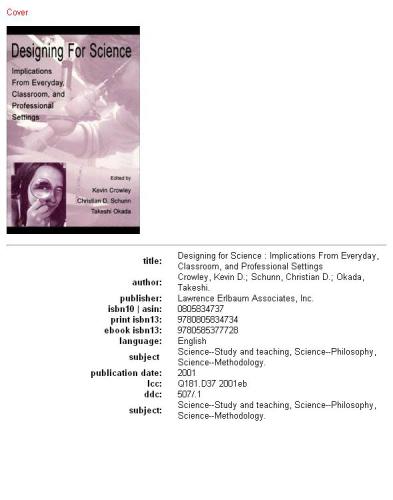
Designing For Science Implications From Everyday Classroom And Professional Settings 1st Edition Kevin D Crowley

  • SKU: BELL-2230952
Designing For Science Implications From Everyday Classroom And Professional Settings 1st Edition Kevin D Crowley
$ 35.00 $ 45.00 (-22%)

4.8

84 reviews

Designing For Science Implications From Everyday Classroom And Professional Settings 1st Edition Kevin D Crowley instant download after payment.

Publisher: Taylor & Francis
File Extension: EPUB
File size: 2.15 MB
Author: Kevin D. Crowley, Christian D. Schunn, Takeshi Okada
ISBN: 0805834737
Language: English
Year: 2001
Edition: 1

Product desciption

Designing For Science Implications From Everyday Classroom And Professional Settings 1st Edition Kevin D Crowley by Kevin D. Crowley, Christian D. Schunn, Takeshi Okada 0805834737 instant download after payment.

This volume explores the integration of recent research on everyday, classroom, and professional scientific thinking. It brings together an international group of researchers to present core findings from each context; discuss connections between contexts, and explore structures; technologies, and environments to facilitate the development and practice of scientific thinking. The chapters focus on: * situations from young children visiting museums, * middle-school students collaborating in classrooms, * undergraduates learning about research methods, and * professional scientists engaged in cutting-edge research. A diverse set of approaches are represented, including sociocultural description of situated cognition, cognitive enthnography, educational design experiments, laboratory studies, and artificial intelligence. This unique mix of work from the three contexts deepens our understanding of each subfield while at the same time broadening our understanding of how each subfield articulates with broader issues of scientific thinking. To provide a common focus for exploring connections between everyday, instructional, and professional scientific thinking, the book uses a "practical implications" subtheme. In particular, each chapter has direct implications for the design of learning environments to facilitate scientific thinking.

Related Products