logo

EbookBell.com

Most ebook files are in PDF format, so you can easily read them using various software such as Foxit Reader or directly on the Google Chrome browser.
Some ebook files are released by publishers in other formats such as .awz, .mobi, .epub, .fb2, etc. You may need to install specific software to read these formats on mobile/PC, such as Calibre.

Please read the tutorial at this link:  https://ebookbell.com/faq 


We offer FREE conversion to the popular formats you request; however, this may take some time. Therefore, right after payment, please email us, and we will try to provide the service as quickly as possible.


For some exceptional file formats or broken links (if any), please refrain from opening any disputes. Instead, email us first, and we will try to assist within a maximum of 6 hours.

EbookBell Team
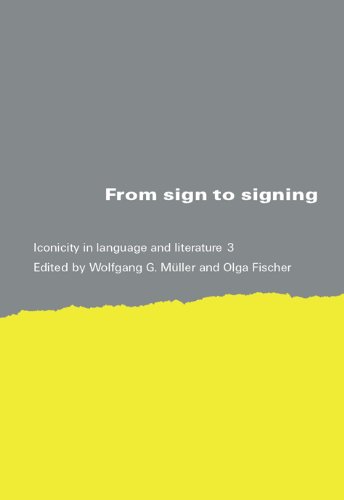
From Sign To Signing Iconicity In Language And Literature 3 Wolfgang G Müller

  • SKU: BELL-2493692
From Sign To Signing Iconicity In Language And Literature 3 Wolfgang G Müller
$ 35.00 $ 45.00 (-22%)

4.8

54 reviews

From Sign To Signing Iconicity In Language And Literature 3 Wolfgang G Müller instant download after payment.

Publisher: John Benjamins Pub.
File Extension: PDF
File size: 2.78 MB
Pages: 438
Author: Wolfgang G. Müller, Olga Fischer
ISBN: 9781588112880, 9789027225931, 9789027296313, 1588112888, 9027225931, 9027296316
Language: English
Year: 2003

Product desciption

From Sign To Signing Iconicity In Language And Literature 3 Wolfgang G Müller by Wolfgang G. Müller, Olga Fischer 9781588112880, 9789027225931, 9789027296313, 1588112888, 9027225931, 9027296316 instant download after payment.

This volume offers a selection of papers given at the Third International Symposium on Iconicity in Language and Literature (Jena 2001). The studies collected here present a number of new departures. Special consideration is given to the way non-linguistic visual and auditory signs (such as gestures and bird sounds) are represented in language, and more specifically in "signed" language, and how such signs influence semantic conceptualization. Other studies examine more closely how visual signs and representations of time and space are incorporated or reflected in literary language, in fiction as well as (experimental) poetry. A further new approach concerns intermedial iconicity, which emerges in art when its medium is changed or another medium is imitated. A more abstract, diagrammatic type of iconicity is again investigated, with reference to both language and literature: some essays focus on the device of reduplication, isomorphic tendencies in word formation and on creative iconic patterns in syntax, while others explore numerical design in Dante and geometrical patterning in Dylan Thomas. A number of theoretically-oriented papers pursue post-Peircean approaches, such as the application of reader-response theory and of systems theory to iconicity.

Related Products