Most ebook files are in PDF format, so you can easily read them using various software such as Foxit Reader or directly on the Google Chrome browser.
Some ebook files are released by publishers in other formats such as .awz, .mobi, .epub, .fb2, etc. You may need to install specific software to read these formats on mobile/PC, such as Calibre.
Please read the tutorial at this link: https://ebookbell.com/faq
We offer FREE conversion to the popular formats you request; however, this may take some time. Therefore, right after payment, please email us, and we will try to provide the service as quickly as possible.
For some exceptional file formats or broken links (if any), please refrain from opening any disputes. Instead, email us first, and we will try to assist within a maximum of 6 hours.
EbookBell Team
0.0
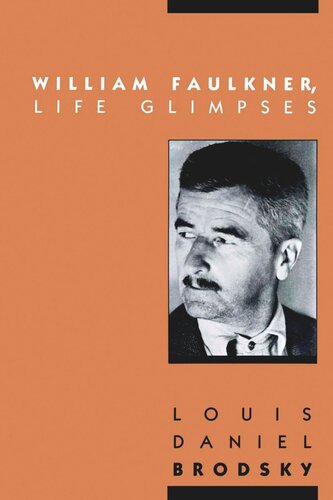
0 reviewsDuring thirty years of literary collecting, Louis Daniel Brodsky has acquired some of the most important source materials on the life and work of William Faulkner anywhere available. Indeed, the Brodsky Collection, now owned by Southeast Missouri State University, has been characterized by Robert Penn Warren as "stupendous." In William Faulkner, Life Glimpses, Brodsky mines this storehouse of previously unpublished material, using interviews, letters, speeches, movie scripts, and notes to enrich our understanding of this well-known Southern writer. The result is a highly readable biography that is thematic and episodic rather than chronological in its organization. Building on specific documents in the collection, Brodsky opens new windows on the parallel development of Faulkner's literary career and personal life. New material on the early poems ''Elder Watson in Heaven" and "Pregnancy" gives insight into Faulkner's developing literary and personal aesthetics during the 1920s and 1930s. Faulkner's metamorphosis from self-doubting, isolated artist to confident public spokesman during the 1940s and 1950s forms the central core of the study. Through previously unavailable screenplays written for Warner Bros. during World War II and an interview with Faulkner's fellow screenwriter Albert I. "Buzz" Bezzerides, Brodsky charts the decline in Faulkner's literary output and his corresponding discovery of a public voice. He shows how Faulkner's astonishingly positive 1950 Nobel Prize acceptance speech was not a sudden about-face from the bleak outlook that had produced The Sound and the Fury. Rather, Faulkner's years in Hollywood showed him that words, even screenplays, could shape the way people think and react. Faulkner's lifelong quest for a "manly" role ended, Brodsky declares, when he took up the mantle of public spokesmanship. In the final chapter, a revealing interview with Faulkner's granddaughter, Victoria Fielden Johnson, paints an insider's portrait of life at the Faulkner home, Rowan Oak. A copy of Faulkner's recipe for curing pork, included in the appendix, emphasizes his longterm struggle to produce fine literature while supplying the everyday needs of a large family. These and other materials, previously unavailable to scholars and the reading public, will broaden and enrich our understanding of one of America's most celebrated writers.